
NEWS
As Part of Government Efforts to Improve Service Quality and Re-engineer Processes, University of Bahrain Develops Service for Tracking Document Verification Requests
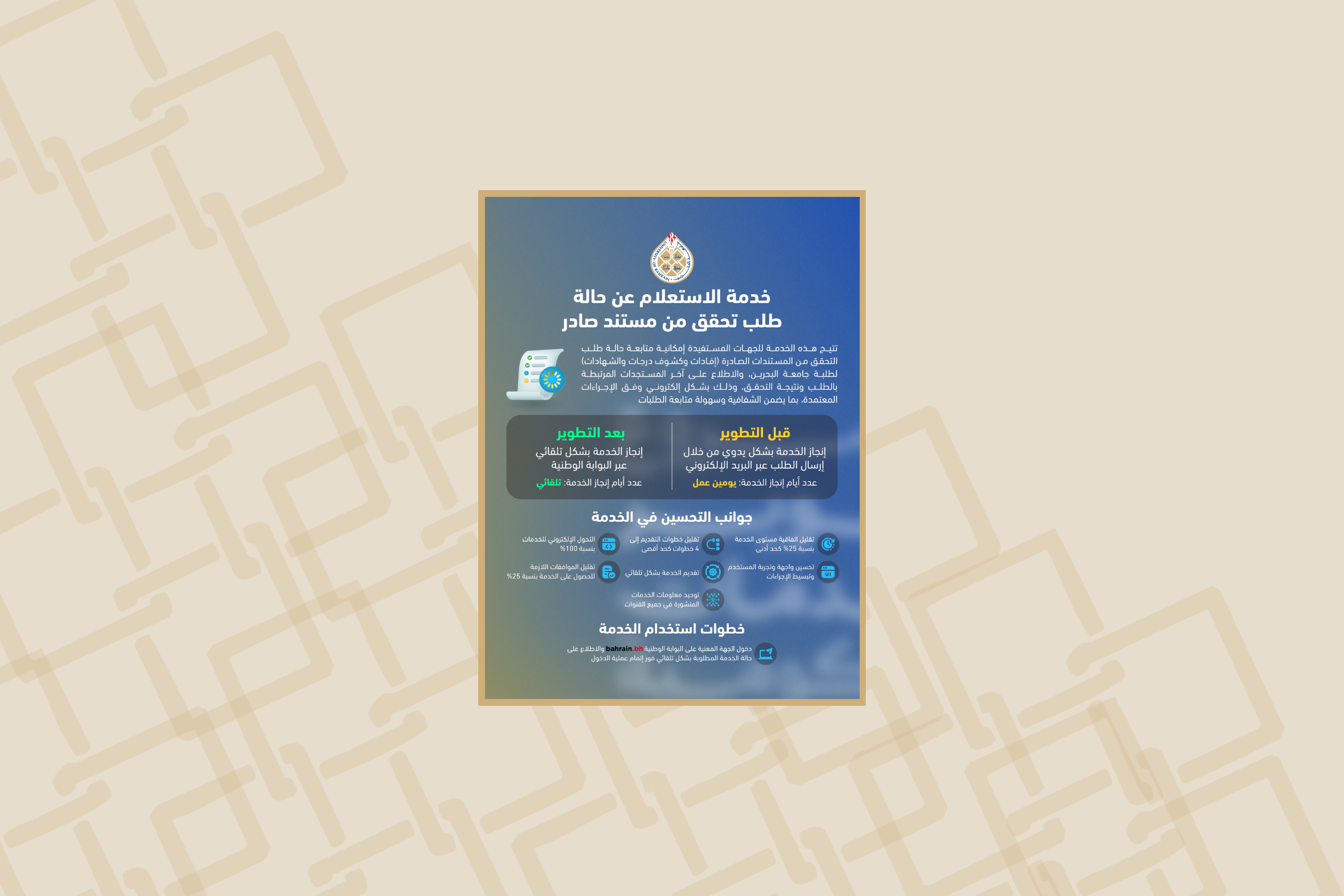
As part of government efforts to improve service quality and re-engineer processes, the University of Bahrain has developed a new digital service for “Tracking the Status of a Document Verification Request,” enabling beneficiary entities to monitor the status of verification requests regarding the authenticity, content, and issuance of statements, transcripts, and certificates issued to university students and to view the latest updates and the verification result electronically, ensuring transparency and ease of follow-up. Under the developed service, the completion time has been reduced from two working days to an automatic and instant procedure, through 100% electronic transformation of the service, a reduction in the service level agreement by a minimum of 25%, a reduction of application steps to a maximum of four steps, an improvement in the user interface and user experience, and the simplification of procedures. In addition, the service is provided automatically, and service information published across all channels has been unified—contributing to accelerating procedures and raising the efficiency of the service provided to beneficiary entities.
In this context, Dr. Fuad Mohammed Al-Ansari, President of the University of Bahrain, affirmed that this service is part of the university’s adoption of innovative digital solutions that enhance the efficiency of administrative operations, align with the requirements of the government’s digital transformation, and contribute to improving the beneficiary experience and simplifying procedures. Dr. Al-Ansari added that the launch of the service reflects the university’s commitment to providing the highest levels of service to beneficiary entities and supporting the principles of governance and transparency by streamlining the verification procedures for the authenticity and issuance of statements, transcripts, and certificates in accordance with approved procedures.
Notably, within the framework of ongoing government efforts to develop and re-engineer public services, over 1,300 government services have been documented, translated, and published. Of these, 800 services across various government sectors have undergone development and re-engineering, based on the proposals and feedback received about government services through the national system for suggestions and complaints, “Tawasul,” investor feedback, and mystery shopper reports for evaluating government services, as well as the launch of guidebooks and service level agreements. This contributes to raising procedural efficiency, improving the quality of services provided, enhancing the beneficiary experience, and supporting the path of government digital transformation.