
SDG 10: Reduced Inequalities Report


SDG 10 – Reduced Inequalities
The University of Bahrain (UoB) is committed to reducing inequalities by widening access to higher education through non-discriminatory admissions and the targeted recruitment of underrepresented groups. We actively promote equality through initiatives such as targeted scholarship pathways with the ISACA Foundation, the AlMabarrah AlKhalifia Foundation (Rayaat University Scholarship Program) and the Royal Humanitarian Foundation, the Female Student Mentorship Program, and the work of the Equal Opportunities Committee.
Mentoring, counseling and peer support programs, accessible facilities, and dedicated disability support services ensure that students of determination and special needs can participate fully in university life, supported by a governance framework anchored in the University’s Gender Equality, Diversity, and Inclusion Policy.
Learning for students
First-generation students
UoB measures first-generation status at the point of entry and can disaggregate it by gender. Of 4,014 women starting a degree, 2,905 were first-generation women, representing approximately 72.37%.
Students from developing countries
UoB monitors international students from developing countries. In the academic year 2024-2025, the University recorded 392 international students from developing countries among 24,485 students, representing approximately 1.60% of the total student population.
Widening access to Higher Education
| Focus area | Our evidence |
|---|---|
| Non-discriminatory admissions policy | The University has a publicly available non-discriminatory admissions policy. The University of Bahrain’s Gender Equality, Diversity, and Inclusion Policy, approved by the University Council and effective 13 November 2025, expressly includes admissions within its scope and establishes equal opportunity without discrimination on the basis of race, religion, nationality, disability, gender, or any other legally protected characteristic.
Section 6.1.1.1 states: “Ensure that recruitment and admissions processes are based on qualifications and competencies, in accordance with the provisions of applicable laws, regulations, and bylaws.”
Admission decisions are determined solely by academic qualifications, program criteria, and applicable interviews, through the Deanship of Admission and Registration. Disability disclosure is intentionally separate from the initial admission process: admitted students with disabilities or chronic health conditions are encouraged to disclose their needs through a separate post-admission process, so that reasonable accommodations can be arranged confidentially. Read more: University of Bahrain’s Gender Equality, Diversity, and Inclusion Policy (PDF) |
| Underrepresented groups – tracking applications | The University systematically measures and tracks applications, admissions, and participation of identified underrepresented and potentially underrepresented groups, through the Deanship of Admission and Registration and the Deanship of Students’ Affairs, in alignment with the Gender Equality, Diversity, and Inclusion Policy and the Supporting and Empowering Students of Determination and Special Needs Policy.
These measures feed into recurring institutional reporting, including the University’s Annual Report 2024–2025 and the National Report on Gender Balance, Institutional Performance (Quantitative Indicators) 2024/2025. |
Underrepresented groups – recruitment
We deliver a range of programs to recruit both staff and students from underrepresented groups.
Scholarship pathways
UoB partners with national and international foundations to reduce financial barriers to university entry, including the ISACA Foundation scholarship, the Rayaat University Scholarship Program with the AlMabarrah AlKhalifia Foundation, and dedicated scholarships through the Royal Humanitarian Foundation.
The Royal Humanitarian Foundation provides 50 scholarships annually for sponsored orphaned students graduating from secondary school, and also operates the Tamyoz Scholarship Program, which applies a family net income threshold of BHD 600.
Students with disabilities and women in STEM
UoB engages with disability-focused organizations, including the Bahrain Paralympic Committee and Bahrain Sports Federation for Disabilities, and recorded 7 newly admitted students with disabilities in 2024-2025.
The Female Student Mentorship Program addresses the gender gap in technology and related fields through mentoring, networking, career guidance and workshops. Participation is not restricted by GPA, and the program is evaluated each semester.
Inclusive staff recruitment
The Directorate of Human Resources operates a public online recruitment portal accessible to international candidates, within the University’s equality, diversity, inclusion, and non-discrimination framework.
In December 2025, UoB recorded 1,205 employees, including 692 academic staff and 513 administrative employees, with academic staff spanning over 30 nationalities.
Anti-discrimination and anti-harassment policies
The University of Bahrain has a Gender Equality, Diversity, and Inclusion Policy, approved by the University Council and effective 13 November 2025, which incorporates provisions on discrimination and harassment. The policy adopts zero tolerance toward gender-based bias, harassment, discrimination, and stereotyping, and applies to academic and administrative staff, students, and relevant University stakeholders. It covers admissions, recruitment, promotion, education, training, employment processes, daily campus interactions, University transactions, and services. It is reinforced by the Policy on Combating Discrimination Against Women.
Concerns can be reported confidentially, and the framework provides protection from retaliation. Under Section 6.4.1, complaints are submitted through a written and signed statement. The receiving entity reviews the complaint and seeks to resolve the issue; where resolution is not possible, or where a violation is involved, the matter is escalated to the competent authority, which forms an investigation committee. The committee submits its recommendations to the University President, and appropriate disciplinary sanctions are imposed based on the findings.
Prevention is supported through regular equality, diversity, inclusion, and anti-discrimination awareness and training for students, faculty members, and administrative staff.
Reporting contacts
Policy contact:
Office of the Director General of Administrative Services
dgas@uob.edu.bh
Student concerns:
Guidance and Mentorship Directorate
Tel: 17438280
Policy documents:
Gender Equality, Diversity, and Inclusion Policy (PDF)
Policy on Combating Discrimination Against Women (PDF)
Equality, Diversity and Inclusion Committee
The University maintains a coordinated institutional network, rather than a single diversity officer, that advises on and implements policies, programs, and training related to equality, diversity, inclusion and human rights across campus.
Equal Opportunities Committee
A standing committee that monitors gender equality performance and reports to the University President. Under Section 5.7 of the policy, it develops and monitors the policy, organizes awareness and training programs, and submits periodic reports on implementation. In 2025, it recommended awareness workshops and lectures informed by a field study on the needs of working women.
Committee for Supporting Students of Determination and Special Needs
Provides dedicated oversight for students with disabilities. The Committee reviews policy implementation, monitors services and reasonable accommodations, coordinates staff training, and periodically evaluates services against national and international standards, with cross-University membership.
Policy ownership and training
The Director General of Administrative Services is the designated owner of the policy. In November 2025, the Unit for Teaching Excellence and Leadership (UTEL), in collaboration with the Equal Opportunities Committee, organized a workshop introducing academic and administrative staff to the policy, its reporting mechanisms, and accountability procedures.
Support for underrepresented groups
Members of the University community have access to mentoring, counseling, and peer support. The Guidance and Counseling Department provides individual and group psychological counseling and social guidance through qualified specialists, and operates the electronic “Consult Your Advisor” service, available through students’ University accounts since 2018. Every student is assigned an academic advisor upon enrollment, available face-to-face and electronically.
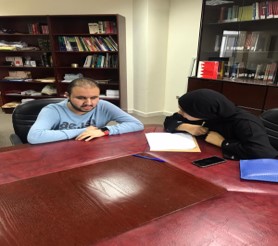
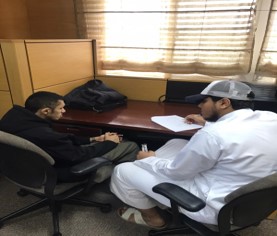
Students with disabilities receive targeted peer support through the Disability Division, which identifies newly admitted students from the beginning of each academic year, provides continuous follow-up, and coordinates student volunteers who assist fellow students on campus and during examination periods. In 2024-2025, all 82 students with disabilities were assigned mentors.
The Peer Learning Program, run through the Student Training and Development Unit, prepares academically distinguished students to support peers in the same specialization, while the Female Student Mentorship Program connects women with academic and industry mentors. An Alumni Affairs Mentorship Program connects students with professional mentors.
Mentoring also extends to faculty through the Postgraduate Certificate for Academic Practice (PCAP), delivered by UTEL, which provides year-long, mentor-supported professional development for academic staff, particularly early-career academics.
Access and support for those with disabilities
The University’s facilities and services are accessible for people with disabilities. Academic buildings across campus feature step-free entrances, ramps, accessible routes, elevators, accessible restrooms, and accessible pathways, and four designated parking spaces for people with disabilities are provided at each academic building. The University also issues special vehicle-access permits according to documented mobility needs. University libraries provide accessible entry and lift access, including a dedicated accessibility lift.
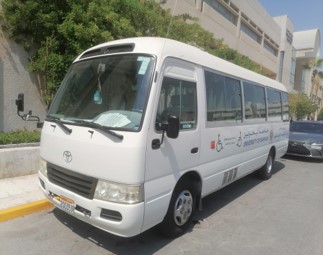
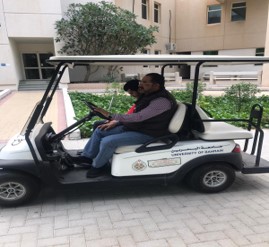
Adapted transportation includes a specially adapted bus equipped with an electric lift for students with complete mobility or complete visual disabilities. On campus, UoB provides three golf carts for students with visual disabilities and 13 wheelchairs, including three powered wheelchairs.
We provide support to students facing a broad range of conditions through the Deanship of Students’ Affairs, the Guidance and Mentorship Directorate, the Department of Academic Support for Students with Determination, and the Disability Division. Support includes personal assistance and student volunteers, examination scribes and additional examination time, sign-language interpretation, access to the Visual Braille laboratory, screen readers and accessible digital materials, course-registration assistance, and psychological and social counseling.
Students can reach a dedicated contact and case-management pathway through the Student Services and Development Department, Tel: 17438180. UoB’s published emergency guidance also explicitly instructs the community to ensure that persons with disabilities have companions and follow safety guidance.
Disability accommodation policy
We have a reasonable accommodation policy for people with disabilities. The University’s Policy to Support and Empower Students of Determination and Special Needs, approved by the University Council and owned by the Deanship of Students’ Affairs, establishes reasonable accommodation as the provision of necessary and appropriate adjustments that enable students with disabilities to participate in academic and University life on an equitable basis.
Requests are received directly from students or through colleges and University departments, formally registered, classified by the support required, assessed against supporting documentation and functional needs, referred to the responsible entity, implemented, and followed up until the accommodation has been delivered. The Committee for Supporting Students of Determination and Special Needs provides formal oversight, reviewing implementation, monitoring services, and recommending improvements.
Accommodations are operationally resourced through adapted disability transportation with an electric wheelchair lift, three campus mobility carts, 13 wheelchairs including three powered wheelchairs, Visual Braille and assistive technologies, sign-language support, accessible library resources, and physical accessibility modifications. In 2024-2025, institutional records document 110 examination-support requests in the first semester, 103 in the second semester, and 25 during the summer semester.
Reasonable accommodations include
- Sign-language interpretation and alternative communication methods
- Braille, screen readers, accessible digital materials and enlarged print
- Examination scribes, additional time, and adapted arrangements
- Academic assistants, peer support, and student volunteers
- Adapted transportation, wheelchairs, and campus mobility support
- Accessible entrances, ramps, elevators, restrooms, and parking
Emergency Evacuation for Students of Determination
If a disability or condition could affect how you leave a building in an emergency, you can get a personal plan for leaving safely. We write it with you, practise it with you and review it with you.
Find further information
Equality, Diversity and Inclusion
We are deeply committed to equality for all students and staff. Explore how we maintain a culture of diversity and inclusivity.
Campus accessibility
Learn more about our campus and its accessibility, including accessible routes, facilities and disability support services.
Student support
We offer various support services for our students. With dedicated staff and resources, we offer a friendly and supportive environment for all.
Sustainable Development Goals
Click to explore our other sustainable development goal pages and get to know how we’re working towards these at the University of Bahrain.
Explore More
 |
 |
 |
 |
 |
 |
 |
 |