NEWS
University of Bahrain Research Team Uses Artificial Intelligence to Forecast Household Waste During Ramadan
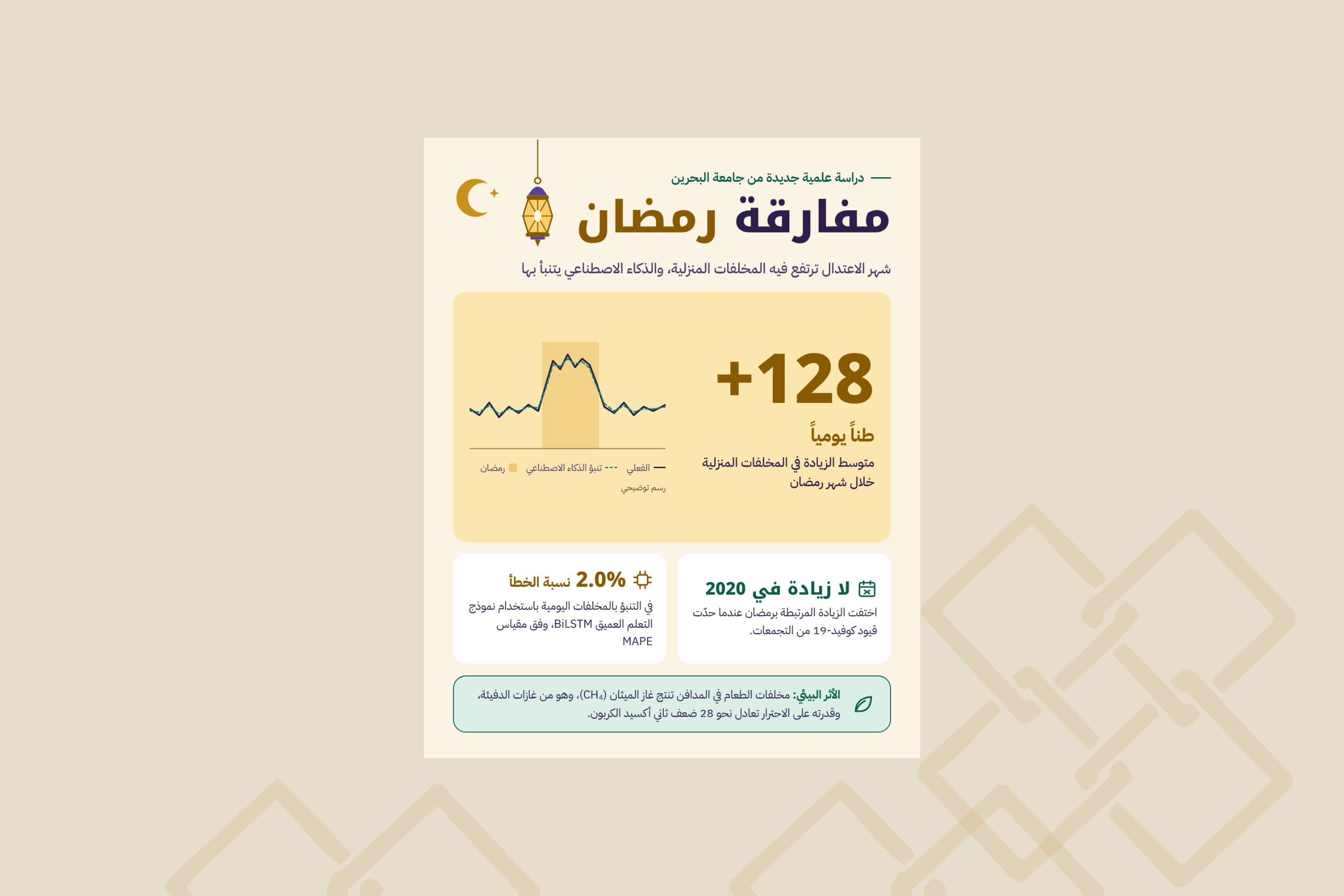
A scientific study by a research team from the University of Bahrain has found that Ramadan is associated with an average increase of about 128 tons of household waste per day. The researchers were able to forecast daily waste quantities with an error rate of no more than about 2% using artificial intelligence.
The study was published in the Journal of Material Cycles and Waste Management, issued by the international publisher Springer Nature. The journal is ranked in the first quartile (Q1) in the 2025 SCImago classification, has an impact factor of 3.8, and is the official journal of both the Japan Society of Material Cycles and Waste Management and the Korea Society of Waste Management.
The team comprised Dr. Majeed Jassim, Associate Professor in the Department of Chemical Engineering; Hussain Hani, a student in the Master of Science in Big Data and Analytics program; and Dr. Gülnur Coşkuner.
The study analyzed daily household waste data for the Kingdom of Bahrain from 2019 to 2022. The results showed that the Ramadan increase is driven by greater food preparation and evening gatherings. This increase disappeared in 2020, when COVID-19 restrictions limited social gatherings, indicating that social activity is the main driver.
The researchers used deep learning models, a branch of artificial intelligence, to forecast daily waste quantities. The best-performing model achieved an error rate of only about 2%.
These findings support advance planning of waste collection and treatment services ahead of the holy month, in service of environmental protection and Bahrain’s sustainability goals. It is worth noting that organic waste accumulated in landfills produces methane, a greenhouse gas that contributes to global warming.