Operations and Institutional Arrangement
SDG 5: Focus Areas
5.3.3 Women’s access schemes
Does your university as a body provide women’s access schemes (e.g. mentoring, scholarships, or other provisions)?
The University of Bahrain (UoB) demonstrates a comprehensive and measurable commitment to advancing gender equality through structured access schemes, financial support, and professional development initiatives. These programs directly contribute to the empowerment of women in higher education and align with the United Nations Sustainable Development Goal 5.
Through these initiatives, the University of Bahrain not only supports women’s access to education but also actively promotes their advancement in academia, leadership, and the workforce.
Female Student Mentorship Program
- Expanding equitable access to professional mentorship and career development.
- Increasing female participation and leadership in technology and STEM.
- Providing same-gender role models that foster confidence and career readiness.
- Challenging stereotypes and promoting gender-inclusive leadership in academia and industry.
The program’s structured mentoring, evaluation, and recognition strengthen UOB’s institutional support for women’s empowerment and contribute to national gender equity objectives.
Evidence
Financial Support and Scholarships
The university recognizes that high tuition fees and living costs can exclude capable students from higher education. To ensure affordability and equitable access, the university offers a multi-layered package of financial support:
- Tuition subsidies: As the Kingdom’s national university, the university keeps tuition low by providing a generous government-funded subsidy: Bahraini nationals pay only about 10 % of the actual cost of their studies, and international students receive an 84 %.
- Scholarships: In partnership with public and private sponsors, the university awards merit-based and need-based scholarships and bursaries. These awards supplement the standard tuition subsidy and are aimed at high-achieving or financially vulnerable students.
 |
20,989 Students obtained partial Financial Support in 2024. | |||
Female students received 65% of financial support in 2024 (13,634 recipients), compared to 35% for males (7,346). This indicates higher female access to financial assistance, aligning with efforts to promote gender equality in education.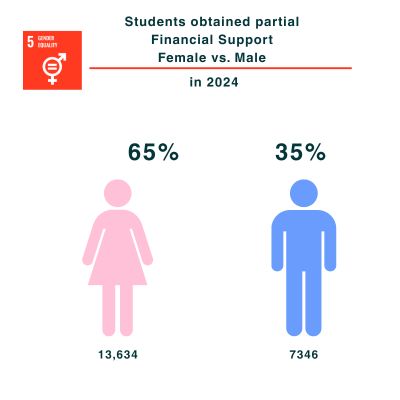
|
||||
 |
546 Students received full fee exemptions in 2024. |  |
15 Contributors for the Exemption Program | |
|
||||
Percentage of Female Receiving Scholarship
The chart below shows strong female representation in scholarships across underrepresented fields from 2022–2025. Engineering maintains ~56% female share, Information Technology ranges 56–58%, and Science reaches 85–89%. Health and Sport Sciences records 79–85%. These figures evidence targeted measures that attract and support women in STEM and related disciplines, aligning with SDG 5 and institutional gender equity goals.

Other Provisions
- Unit for Teaching Excellence and Leadership (UTEL):
The Unit for Teaching Excellence and Leadership (UTEL) at the University of Bahrain actively supports SDG 5 by promoting gender equity in professional development and academic advancement. Through accredited programs recognized by Advanced HE (UK), UTEL ensures equal access for women and men to high-quality training in teaching and leadership. The unit delivers workshops, seminars, and tailored support that empower faculty—particularly women—to enhance their skills and progress in their careers. By fostering inclusive participation, encouraging research in teaching and learning, and collaborating with local and international partners, UTEL contributes to creating equitable opportunities across the higher education sector in Bahrain.
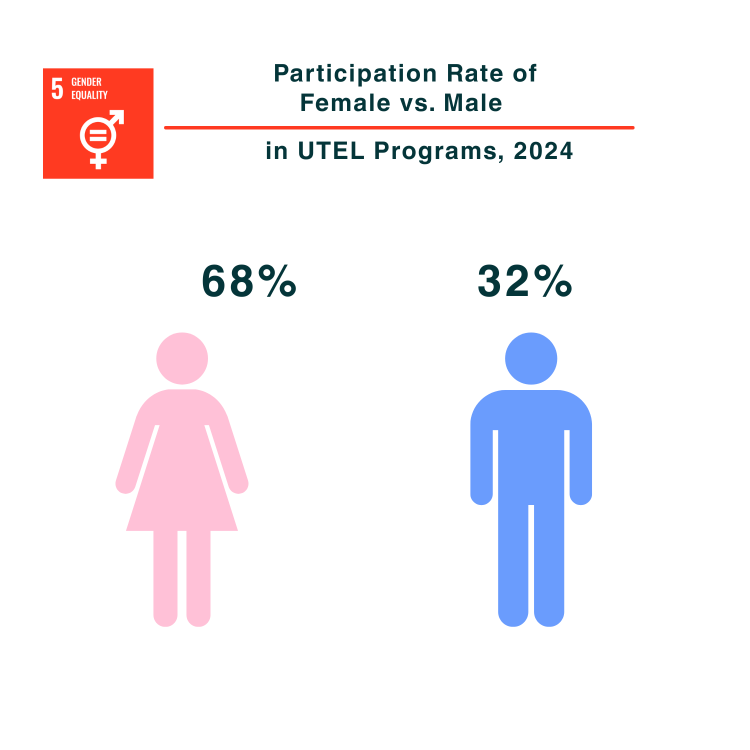
The participation rate in UTEL programs in 2024 shows that females constituted 68% of participants, compared to 32% males.
2. Coursera Partnership:
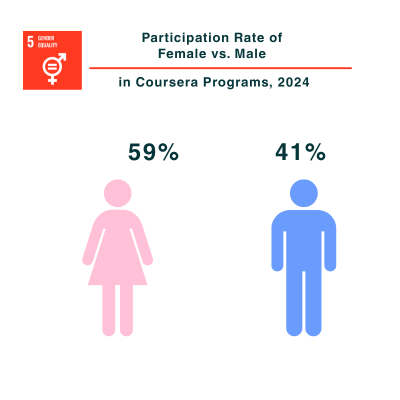
The University of Bahrain (UoB) has partnered with Coursera, a leading global online learning platform, to expand lifelong learning, digital upskilling, and professional development opportunities for students, graduates, faculty, administrative staff, and registered members of the public. This initiative promotes inclusive and equitable access to high-quality education, empowering learners to strengthen their career readiness and adapt to national workforce needs. In support of SDG 5, the program ensures broad participation across genders, with women representing 59% of all learners—demonstrating strong female engagement in digital learning and professional advancement.
In 2024, participation in Coursera programs was 59% female and 41% male.