NEWS
University of Bahrain and BENEFIT Advance AI Research, Government Collaboration, and National Capacity Building
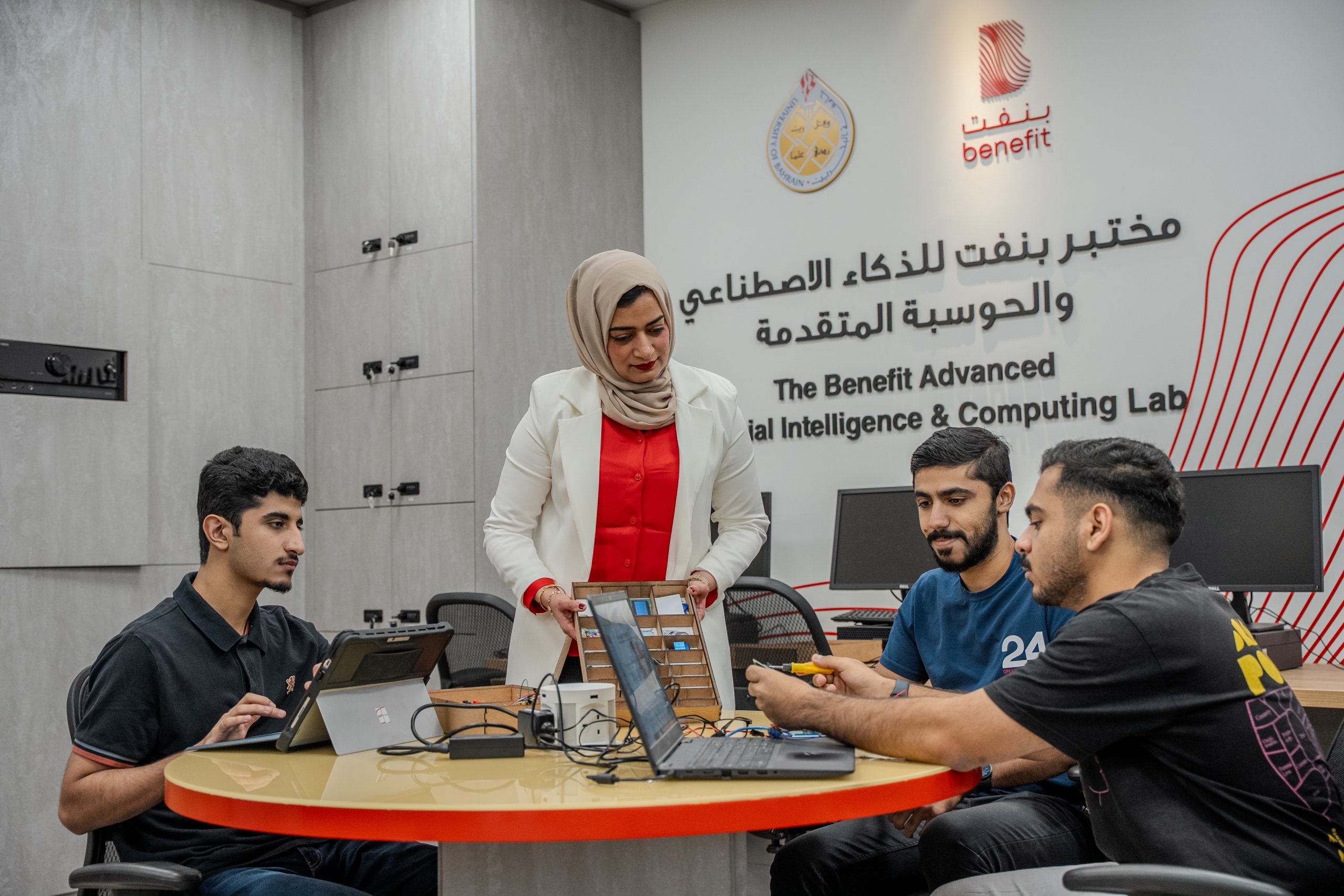
Since the inauguration of the BENEFIT Advanced AI & Computing Lab on December 23, 2021, the University of Bahrain and The BENEFIT Company have maintained a strategic partnership that connects higher education, industry, government, and international research organizations to advance artificial intelligence, high-performance computing, scientific research, and digital innovation. During 2024–2025, the Lab continued to expand its role as a shared platform for research, knowledge exchange, skills development, and applied technological solutions.
The Lab operates through a structured governance model that supports collaboration between UOB, BENEFIT, and national stakeholders, including representation from Bahrain’s Information & eGovernment Authority. Its wider activities have also involved government entities, researchers, startups, universities, and international scientific organizations, creating opportunities to connect advanced academic research with national and industry priorities.
International Research and Scientific Data Collaboration
International scientific collaboration represents a major dimension of the Lab’s work. During October 2024 to May 2025, UOB researchers collaborated with CERN on high-performance computing research associated with the Compact Muon Solenoid experiment at the Large Hadron Collider. Using the Lab’s GPU infrastructure, researchers developed and tested approaches for optimizing particle-track reconstruction and processing large-scale experimental scientific data. The collaboration resulted in research outputs documented through the CERN Repository and EPJ Web of Conferences.
The Lab also supported international research collaboration with institutions including the University of Málaga and research partners in Tunisia. UOB’s experience in establishing and operating an academic AI and high-performance computing laboratory was further documented in a peer-reviewed Springer chapter addressing the challenges and lessons of establishing academic AI laboratory infrastructure, providing transferable insights for universities and research institutions in the GCC.
AI and Data Science Supporting National Sustainability Priorities
The Lab has also enabled cooperation with Bahrain’s public sector on data-driven research relevant to national sustainability challenges. Collaboration with the Electricity and Water Authority provided UOB researchers with multi-year electricity-consumption datasets covering different economic sectors. Using machine learning, deep learning, regression, and time-series forecasting, the research examines carbon footprints and forecasts CO₂ emissions, generating evidence relevant to Bahrain’s Net-Zero 2060 objectives.
This work demonstrates how university research infrastructure can support government stakeholders through data analysis, modeling, forecasting, and evidence-informed approaches to climate and energy planning.
Free AI and High-Performance Computing Capacity Building
Beyond research, the BENEFIT Advanced AI & Computing Lab provides education and technical capacity building to students, researchers, government employees, educators, entrepreneurs, and other external beneficiaries. During 2024–2025, Lab services were provided free of charge to eligible users, while more than 500 individuals received training through AI, high-performance computing, postgraduate research, and government-focused capacity-building activities.
Training and knowledge-transfer activities covered areas including Python, data science, machine learning, deep learning, Linux, high-performance computing, GPU programming, and cybersecurity. The Lab also maintains open technical documentation providing practical guidance on research-computing tools and environments, extending access to technical knowledge beyond formal university courses.