
NEWS
As Part of Government Efforts to Improve Service Quality and Reengineer Services, University of Bahrain Develops Its Course Equivalency Request Service
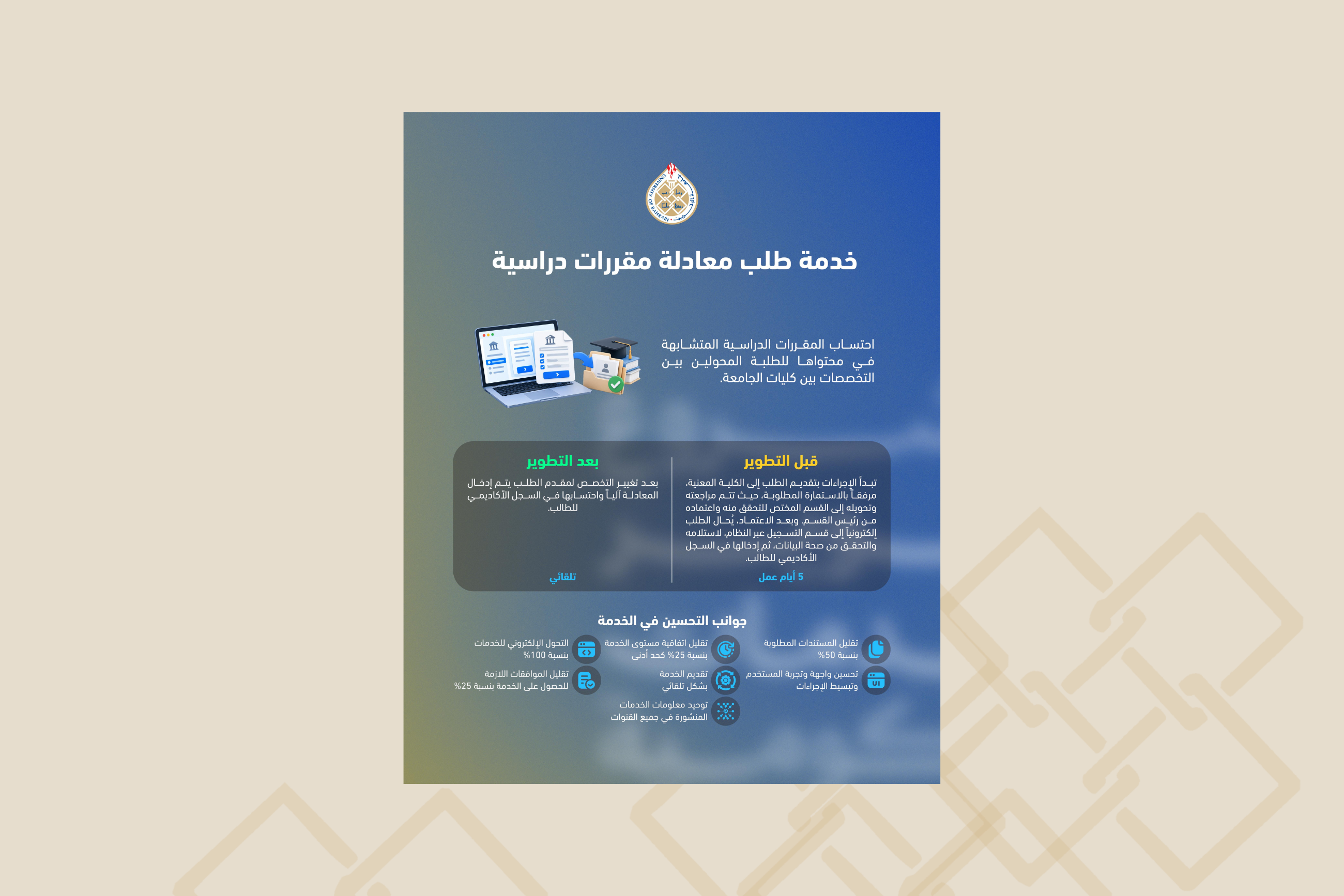
As part of government efforts to continue improving the quality of services and reengineering them, the University of Bahrain has developed its Course Equivalency Request service, which allows students transferring between majors within the University to have previously passed courses credited, provided their content matches that of courses in the new major.
Under the developed service, the equivalency is entered automatically in the student’s academic record immediately upon transfer and is completed automatically, whereas it previously required four steps and took five working days. The improvements include reducing the number of required documents by 50%, shortening the service level agreement (SLA) by at least 25%, fully digitizing the service (100%), improving the user interface and experience, simplifying procedures, delivering the service automatically, reducing the approvals required to obtain it by 25%, and standardizing the service information published across all channels.
In this context, Dr. Fuad Mohammed Al-Ansari, President of the University of Bahrain, stressed that developing the Course Equivalency Request service is a significant step in facilitating academic procedures for students transferring between majors. The service automatically credits courses that meet the equivalency requirements to the student’s academic record following the transfer, saving time and effort and giving students a smoother experience in completing their academic path.
Dr. Al-Ansari added that developing this service reflects the University’s efforts to enhance its services and use digital initiatives to raise the efficiency of procedures and make them easier, thereby improving the quality of the student experience and supporting the University’s efforts to keep pace with digital transformation.
It is worth noting that, as part of ongoing government efforts to develop and reengineer government services, more than 1,300 government services have been documented, translated and published, of which 800 have been developed and reengineered across government sectors. This was based on suggestions and feedback received through the national suggestions and complaints system “Tawasul”, investor feedback, and secret shopper reports evaluating government services. Guidelines and SLAs have also been launched, contributing to raising the efficiency of procedures, improving the quality of services, enhancing the beneficiary experience, and supporting the government’s digital transformation.