

Operations and Institutional Arrangement
SDG 13: Focus Areas
13.2.1 Indicator: Low-carbon energy tracking
Does your university as a body measure the amount of low carbon energy used across the university?
Key Actions and Evidence
Low-Carbon Energy Use and Carbon Footprint Assessment (Scopes 1 & 2)
The University of Bahrain (UOB) is committed to quantifying energy use, greenhouse gas emissions, and the contribution of low-carbon and renewable energy across its operations as part of its institutional sustainability and climate-action framework. This includes tracking annual electricity consumption, assessing renewable and low-carbon energy generation, calculating Scope 1 and Scope 2 emissions, and monitoring energy use relative to the University population.
Low-Carbon Energy and Emissions Tracking
At the Sakhir Campus, the principal quantified operational emission sources are transportation (Scope 1) and purchased electricity (Scope 2).
UOB provides free shuttle services for students and staff traveling between buildings, colleges, and parking areas, with transportation support also available for people with disabilities. Emissions from the University’s on-campus bus fleet are included within the Scope 1 transportation inventory.
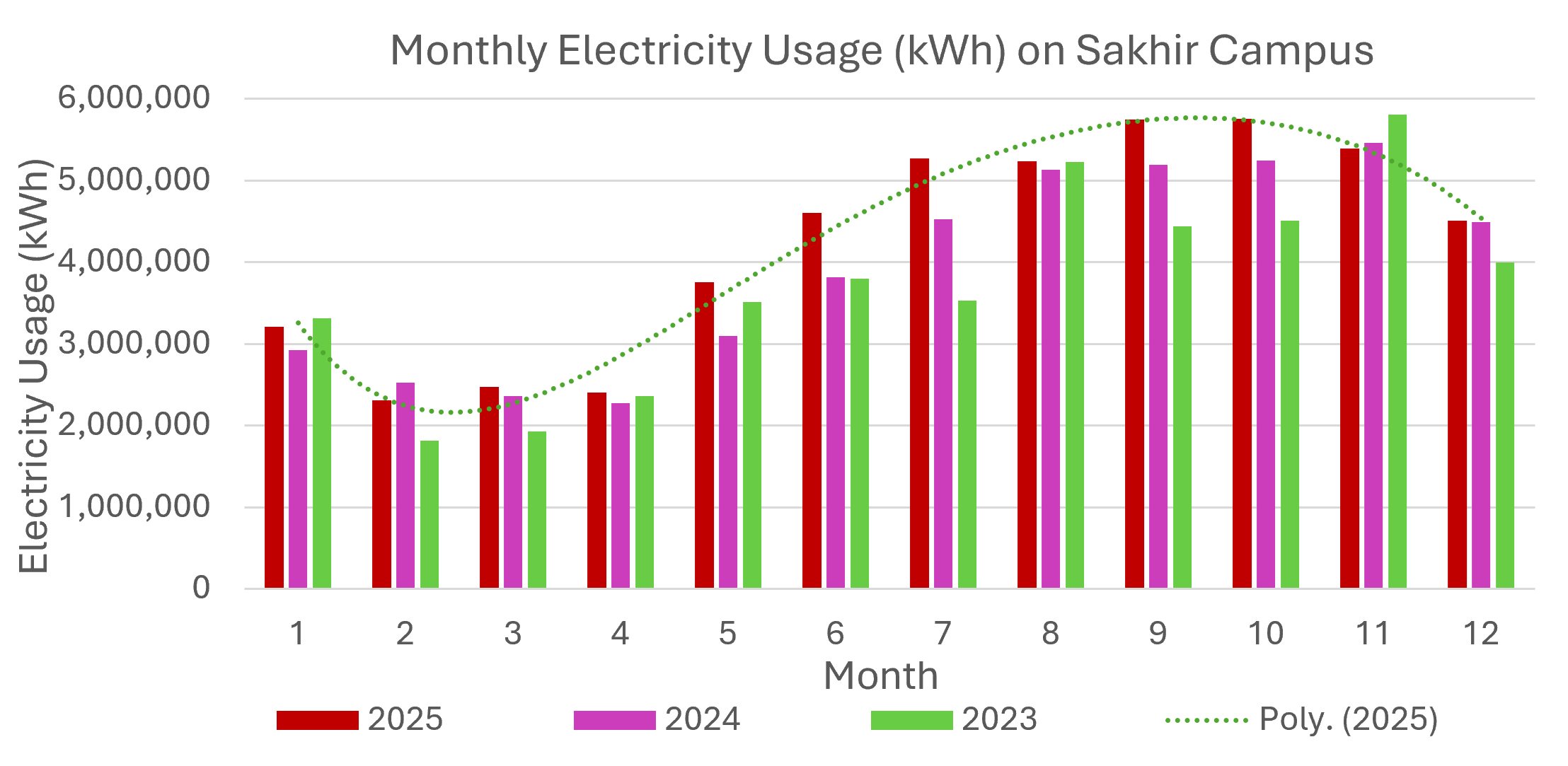
For Scope 2, UOB calculates emissions from purchased electricity consumed across Sakhir Campus facilities. Electricity-consumption data are derived directly from official bills issued by Bahrain’s Electricity and Water Authority and include the electricity required for laboratory equipment, lighting, cooling, and other academic and administrative operations.
2025 Electricity Consumption
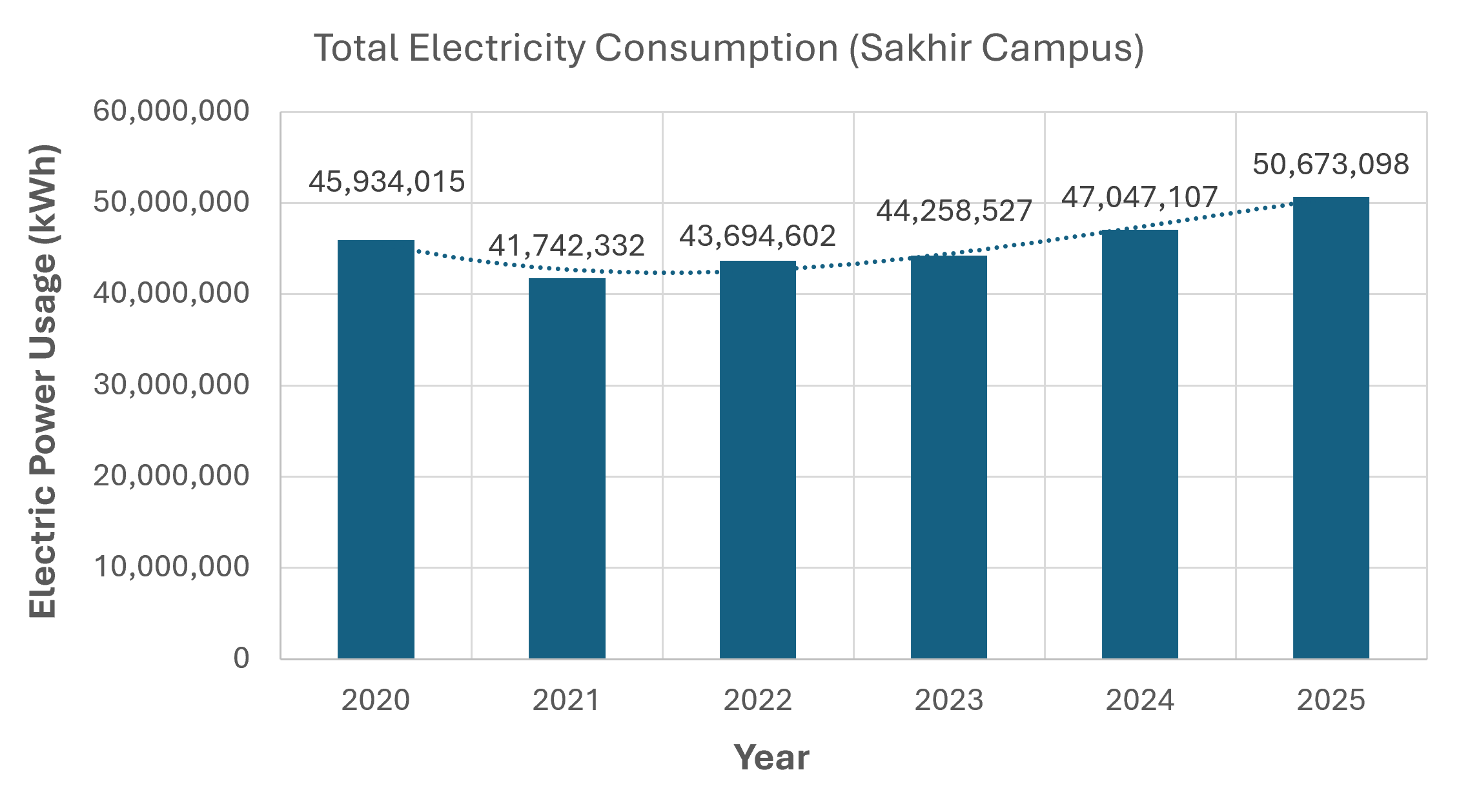
In 2025, Sakhir Campus consumed 50,673,098 kWh of electricity, representing an approximately 7.7% increase compared with 2024, when consumption was 47,047,107 kWh.
Considering a University population of approximately 29,750 people—comprising more than 28,000 students, 1,242 full-time faculty/staff, and 499 part-time faculty—electricity consumption was approximately 1,703 kWh per person.
University of Bahrain, Sakhir Campus
University of Bahrain, Sakhir Campus
Greenhouse Gas Emissions Assessment
UOB’s carbon estimation for 2025 was conducted with reference to the Greenhouse Gas Protocol, an internationally recognized greenhouse gas accounting and reporting framework for measuring direct and indirect organizational emissions.
Methodology Reference: Greenhouse Gas Protocol
Scope 1: Transportation
Scope 1 includes direct emissions associated with the University’s bus and shuttle fleet. 2025 Scope 1 emissions from transportation: 875.93 tCO₂e, representing 3.51% of the University’s combined Scope 1 and Scope 2 emissions.
Scope 2: Purchased Electricity
Total purchased electricity consumption at Sakhir Campus in 2025 was 50,673,098 kWh, resulting in 24,069.72 tCO₂e of Scope 2 emissions. Scope 2 electricity emissions represent 96.49% of the University’s combined Scope 1 and Scope 2 emissions, identifying purchased electricity as the dominant operational emissions source.
2025 Scope 1 and Scope 2 Carbon Footprint
| Scope | Emission Source | Emissions (tCO₂e) | Contribution |
|---|---|---|---|
| Scope 1 | University shuttle/bus fleet | 875.93 | 3.51% |
| Scope 2 | Purchased electricity | 24,069.72 | 96.49% |
| Total | Scope 1 + Scope 2 | 24,945.65 | 100% |
SDG 13.2: Integrate Climate Change Measures into Policies and Planning
Through recurring electricity measurement, greenhouse gas accounting, and quantified renewable-energy generation, UOB maintains an institutional mechanism for tracking the transition from purchased electricity toward low-carbon energy. The 46.2 MWp solar PV system will provide a measurable source of on-campus renewable electricity, enabling UOB to quantify renewable generation against total campus energy consumption and monitor progress toward reducing dependence on carbon-intensive electricity.
The 2025 assessment also provides a quantitative evidence base for prioritizing future interventions. As 96.49% of the measured Scope 1 and Scope 2 footprint originates from purchased electricity, measures that reduce grid electricity demand or increase renewable-energy generation offer the greatest potential for reducing UOB’s operational carbon footprint.
Relevant SDG 13 Targets and Indicators
-
13.2.1 Low-carbon energy tracking: measurement of the amount of low-carbon energy used across the University.
- 13.2.2: Measurement and monitoring of greenhouse gas emissions and climate-related performance.
Conclusion
In 2025, UOB strengthened its climate-action monitoring by quantifying annual electricity consumption and calculating Scope 1 transportation and Scope 2 electricity emissions using a recognized greenhouse gas accounting approach. With 50,673,098 kWh of electricity consumed and 24,945.65 tCO₂e of combined Scope 1 and Scope 2 emissions, the assessment establishes a clear evidence base for institutional climate planning.
The finding that 96.49% of quantified emissions derive from purchased electricity identifies energy efficiency, renewable energy, and low-carbon electricity as priority areas for reducing the University’s operational carbon footprint.
Solar Power Plant Project: 46.2 MWp Renewable Energy Transition
University of Bahrain Strategic Partnership with the Electricity and Water Authority
The University of Bahrain (UOB), in collaboration with Bahrain’s Electricity and Water Authority (EWA), is implementing a 46.2 MWp photovoltaic solar-energy project at the Sakhir Campus. The project represents one of the largest renewable-energy initiatives undertaken at an educational institution in Bahrain and directly supports UOB’s transition toward low-carbon energy and reduced dependence on conventional electricity sources.
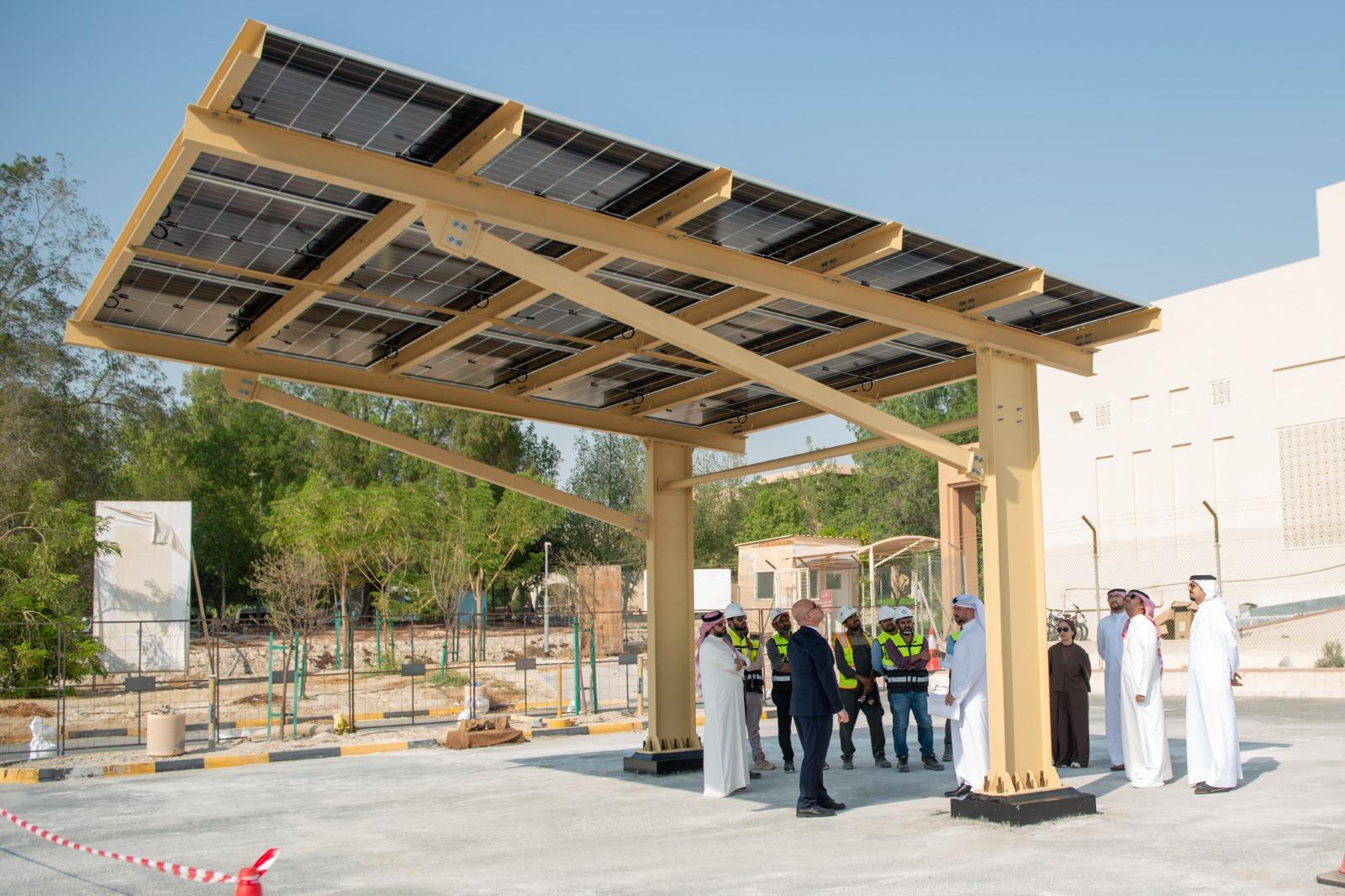
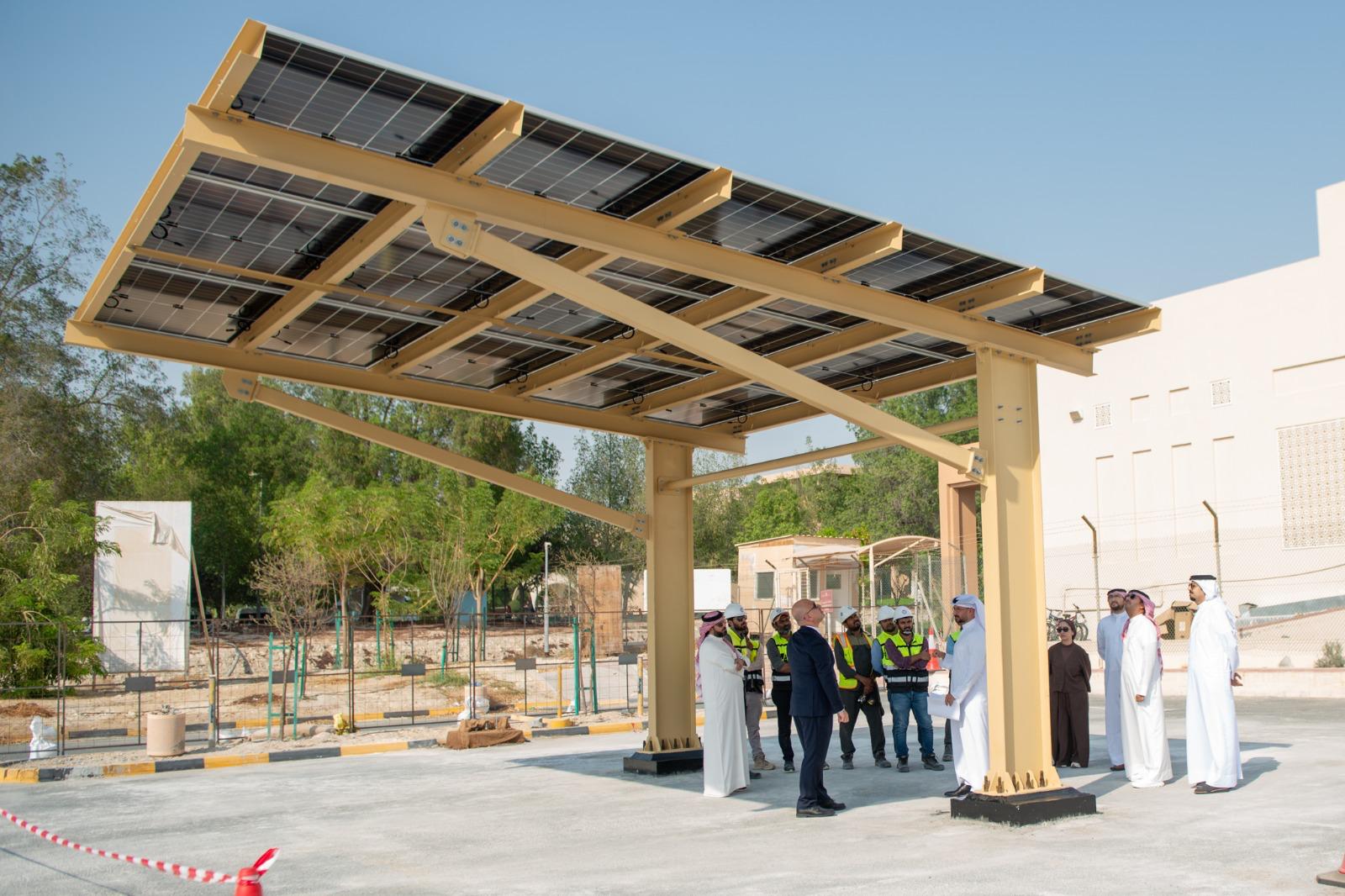
46.2 MWp Solar Power Plant Partnership with EWA at Sakhir Campus
Project Scale, Implementation, and Carbon Impact
Project Scale and Implementation
The project comprises 64,606 solar panels, including 24.7 MW installed across car-parking areas and 21.5 MW through ground-mounted systems, providing a total installed capacity of 46.2 MWp. The system is expected to generate approximately 70 GWh of renewable electricity annually.
The project is being implemented under a Power Purchase Agreement (PPA) using a Build, Own, Operate, and Maintain (BOOM) model. EWA is investing approximately BHD 9 million in the development of the solar PV system.
Carbon Reduction and Low-Carbon Energy Impact
Once operational, the solar PV system is projected to reduce carbon emissions by approximately 35,000 tonnes of CO₂ annually. UOB states that the system will enable the University to meet its daytime electricity requirements through direct solar consumption, with surplus renewable electricity capable of being exported to Bahrain’s national grid.
This investment directly addresses UOB’s principal operational emissions source. Electricity accounted for 96.49% of UOB’s quantified Scope 1 and Scope 2 emissions in 2025, making renewable electricity generation a priority institutional measure for reducing the University’s carbon footprint.
National Climate Alignment, SDG 13, and Key Project Outcomes
Alignment with National Climate and Renewable-Energy Goals
The solar project contributes to Bahrain’s national efforts to diversify energy sources, reduce dependence on natural gas, expand renewable-energy generation, improve energy efficiency, and achieve carbon neutrality by 2060. The project also positions UOB as a large-scale institutional implementation site for renewable-energy generation within Bahrain’s higher-education sector.
Alignment with SDG 13: Climate Action
The project provides institutional evidence of UOB’s integration of climate action into campus energy planning and operations, particularly through:
- SDG 13.2: Integrating climate-change mitigation and renewable-energy measures into institutional planning and campus operations; and
- SDG 13.4: Advancing UOB’s institutional transition toward carbon neutrality and low-carbon energy.
Key Project Outcomes
| Indicator | Project Outcome / Target |
|---|---|
| Solar PV capacity | 46.2 MWp |
| Solar panels | 64,606 |
| Expected renewable-energy generation | ~70 GWh/year |
| Expected carbon-emission reduction | ~35,000 tCO₂/year |
| EWA investment | ~BHD 9 million |
| Energy impact | Meet UOB daytime electricity demand through direct solar consumption, with surplus export capability |
| Expected operation | Q3 2026 |
Implementation Timeline, Conclusion, and Public Evidence
Implementation Timeline and Carbon-Neutrality Commitment
The solar PV system is expected to become operational in Q3 2026. UOB’s current public SDG 13 evidence states that the University is expected to achieve carbon neutrality in 2027, following completion and operation of the solar PV project.
Conclusion
The 46.2 MWp solar PV project demonstrates UOB’s transition from carbon measurement to large-scale institutional emissions reduction. Through its partnership with EWA, UOB is investing in renewable-energy infrastructure expected to generate approximately 70 GWh of clean electricity annually and avoid approximately 35,000 tonnes of CO₂ emissions each year. By directly addressing purchased electricity, UOB’s dominant quantified operational emissions source, the project provides measurable evidence of the University’s integration of renewable energy, carbon reduction, and long-term decarbonization into institutional climate planning.
Public Evidence

Explore More
 |
 |
 |
 |
 |
 |
 |
 |